Connecting Industry and Academia: Sanjel Energy Continues Collaboration with the University of Alberta
For the fourth year, Sanjel Energy Services returned to the University of Alberta to share industry knowledge and real-world experience with the next generation of petroleum engineers.
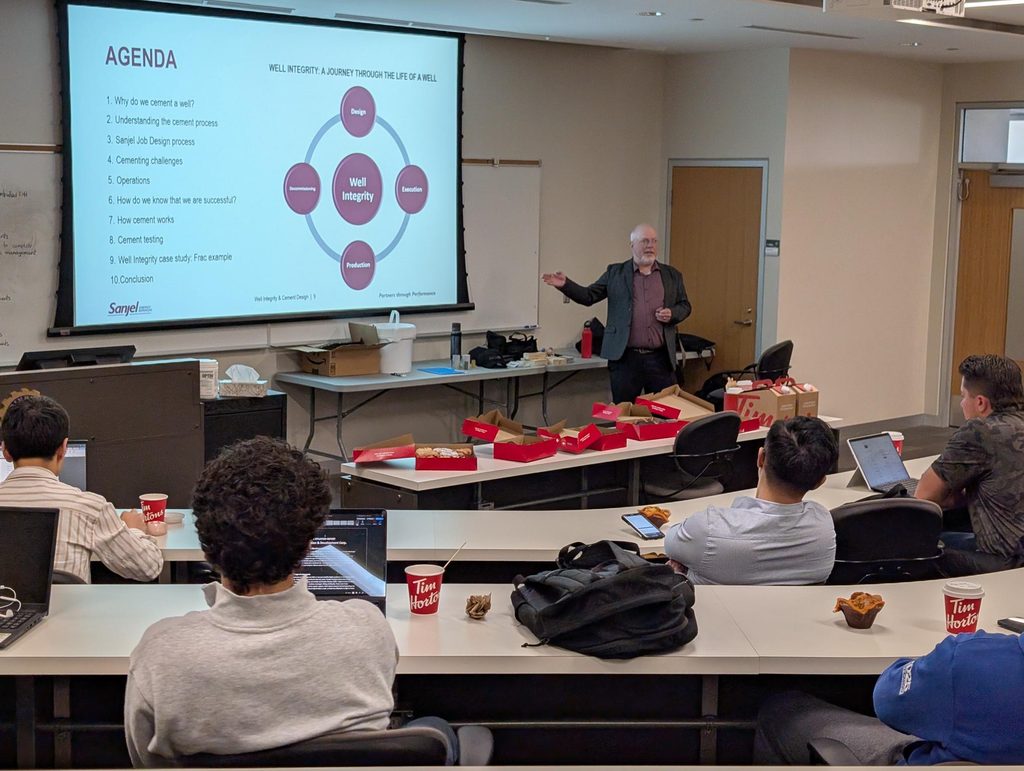
As part of PETE 476 – Well Completions, Sanjel team members Simon Iremonger (Product Innovation Domain Leader), Gunnar DeBruijn (Manager, Innovation) and Sarah Whitton (Technology Implementation Domain Leader) joined approximately 30-40 undergraduate and graduate students for a guest lecture focused on cementing and well integrity and their critical role throughout the lifecycle of a well.
Bringing real-world well integrity challenges into the classroom
The lecture explored the cementing process from job design and laboratory testing through field execution and post-job evaluation. Students learned how cement contributes to zonal isolation, environmental protection, casing support and long-term well integrity, including the importance of effective isolation in helping ensure frac intervals remain accessible for stimulation and production. The discussion also highlighted how decisions made during drilling and well design can influence cementing outcomes.
The discussion also examined how increasingly complex wells and emerging applications, including carbon and hydrogen storage, are creating new well-integrity challenges and opportunities for research and technology development.
Importantly, the session wasn’t intended as a product or recruitment presentation. Its focus was on knowledge sharing, providing students with insight into real industry challenges, current research, and lessons learned from field experience.
A relationship built on knowledge sharing
The annual lecture is one part of Sanjel Energy’s relationship with the University of Alberta, which spans more than a decade of collaborative research, student engagement and technical knowledge sharing.
Through Simon Iremonger’s role as an Adjunct Professor, Sanjel maintains connections with faculty, graduate students and researchers exploring well cementing and integrity challenges.
Current areas of collaboration include long-term cement durability, carbon and hydrogen storage well integrity, alternative remedial sealants, cement sealing performance and leakage prevention. Sanjel is also working with the University on initiatives related to casing deformation mitigation and self-healing cement systems.
Bringing this work into the classroom gives students a look at the challenges the industry is actively working to solve, and how research can help us anticipate what’s next, identify challenges earlier and develop practical solutions.
Looking ahead
This year’s students brought thoughtful questions and strong engagement to the discussion. Having Simon, Gunnar and Sarah share perspectives from different roles and technical backgrounds also demonstrated how research, innovation and operational experience can come together to tackle complex engineering challenges.
Sanjel plans to continue the lecture as an annual activity. Based on student interest this year, future sessions will also incorporate expertise from STEP Energy Services in areas such as fracturing and coiled tubing, giving students an even broader view of how engineering, technology and field operations come together.